Lessons From Vietnam 1968: Remembering the Marines Who Carried the Load
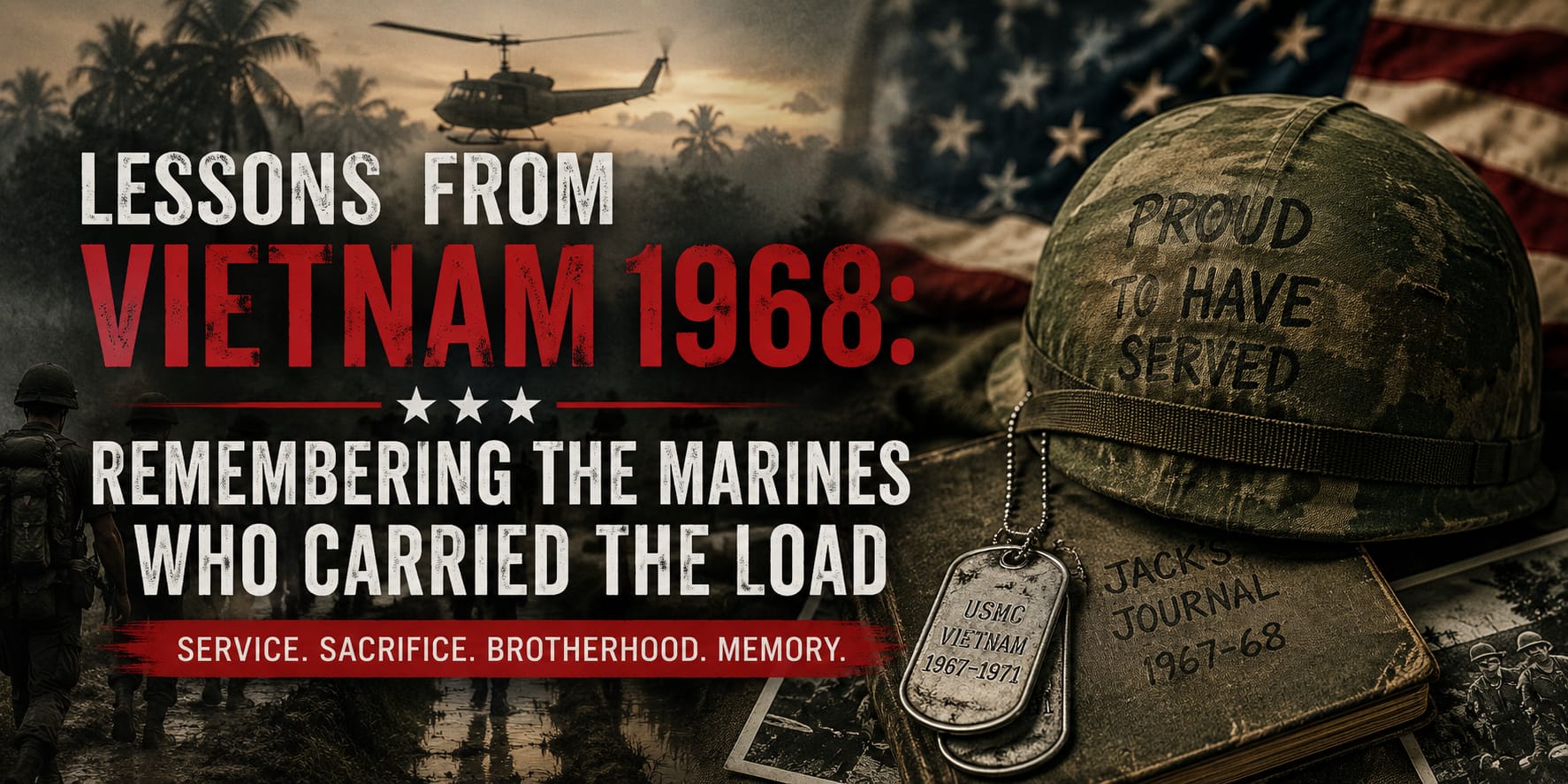
In a recent episode of the Jocko Podcast, Jocko Willink and Echo Charles reflected on the book Vietnam 68: Jack’s Journal by Sergeant Major Jack W. Jonnal, a Marine who served in World War II, Korea, and Vietnam. The discussion was not focused on politics or strategy. It focused on Marines, leadership, sacrifice, memory, and the reality of life in combat.
For members of MCL 1490, the podcast served as a reminder that history is not abstract. It lives through the stories, journals, photographs, and memories left behind by those who served.
Jack Jonnal’s story began long before Vietnam. Rejected by the Marine Corps during World War II because of poor eyesight and a history of tuberculosis, he joined the Merchant Marine at 17 years old. Later he served in the Army during the occupation of Japan, fought in Korea, earned a Purple Heart, and eventually joined the Marine Corps in 1952 during the Korean War.
By the time he arrived in Vietnam in late 1967, he was no inexperienced young Marine. He was an old salt with decades of service behind him. Yet even after serving in three wars, the realities of Vietnam still weighed heavily on him.
One of the strongest themes throughout the podcast was the importance of preserving memories.
Jocko repeatedly emphasized how valuable journals, letters, and notes become over time. While deployed, Jack Jonnal wrote his journal entries on scraps of paper, calendars, notebooks, envelopes, and ration boxes. Those small notes eventually became a firsthand historical record of Marines serving during some of the hardest periods of the Vietnam War.
The conversation highlighted something many veterans understand. Memories fade unless they are preserved. Stories disappear unless someone writes them down.
For organizations like MCL 1490, that lesson matters.

Every member carries stories, experiences, friendships, hardships, and moments that future generations may never hear unless they are documented. A short journal entry, an old photograph, or a recorded memory becomes part of preserving the legacy of Marines who served.
Much of the podcast focused on the day-to-day reality of Vietnam.
Young Marines rotated into combat zones while exhausted veterans rotated home. Patrols moved through rice paddies filled with booby traps and hidden mines. Marines spent nights in bunkers waiting for attacks and days conducting patrols through dangerous terrain.
The entries from Jack’s journal often shifted between ordinary moments and devastating loss within a single page.
One day included coffee runs and conversations in the mess hall.
The next included identifying the bodies of Marines killed in action.
As a first sergeant and later sergeant major, Jack carried responsibilities beyond combat leadership. He visited wounded Marines in hospitals, inventoried the personal belongings of those killed, and wrote letters to grieving families back home.
One section from the podcast stood out deeply.
After a Marine was killed while trying to rescue another wounded Marine, Jack wrote a letter to the Marine’s wife explaining how her husband died. He wanted her to know that her husband died helping another Marine during combat.
Later, the wife replied and thanked him. She wrote that now she knew her husband was a hero to both her and their son.
Those moments reflected one of the central values repeated throughout the discussion: Marines take care of their own.
The podcast also explored leadership and accountability.
One story described a young corporal whose patrol accidentally wounded one of their own Marines during a nighttime ambush. At first, the patrol falsely reported that the enemy caused the casualty. Later, the corporal stepped forward voluntarily and corrected the report.
Instead of destroying the Marine’s career, the battalion commander recognized the honesty it took to admit the mistake. The colonel explained that accidents happen in war, but covering up mistakes prevents lessons from being learned.
Jocko and Echo used that story to discuss leadership far beyond combat. Accountability, honesty, and ownership matter in military service, leadership, family life, and everyday responsibility.
The podcast repeatedly returned to the emotional burden carried by senior enlisted leaders.
Jack described seeing young Marines killed in combat and wondering if he subconsciously viewed them as sons. He wrote about memorial services, casualty notifications, and the emotional weight of watching Marines leave on dangerous missions knowing some would never return.
One of the most powerful passages described a dead recon Marine carrying a small American flag inside his uniform while on patrol. Jack contrasted that image with anti-war protesters burning flags back home during the same period.
The passage reflected the divide many Vietnam veterans experienced during and after the war.
The discussion also captured the strong connection many veterans still feel toward the Marines who served in Vietnam. Jocko spoke openly about how Marines and SEALs from that era became heroes to many who later served after them. The stories, sacrifice, toughness, and brotherhood of Vietnam veterans shaped future generations of military service members.
Near the end of the episode, Jocko read a letter originally published during the Vietnam War describing the average young Marine in combat.
The letter explained that many of those Marines were only 18 or 19 years old. They listened to rock music, missed home, joked with friends, cleaned their rifles, carried wounded Marines, and fought through exhaustion and fear every day.
The final line captured the spirit of the entire podcast:
“He is now 19, a veteran, and fighting to make it to 20.”
That line served as a reminder of how young many combat Marines truly were.
For MCL 1490 members, the podcast was more than a book review. It was a reflection on service, sacrifice, brotherhood, leadership, and memory.
The stories from Vietnam 1968 remind us why organizations like MCL 1490 matter today. They preserve connection between generations of Marines. They create spaces where stories are remembered instead of forgotten. They honor the Marines who carried the burden before us while continuing to support those serving today.
The sacrifices described throughout Jack Jonnal’s journal were real. The Marines he wrote about were real. Their stories deserve to be remembered.
And as the podcast emphasized throughout the discussion, one of the best ways to honor them is simple:
Write the stories down before they disappear.