From Embassy Guard to Educator: Peter Daniel Cook on Service, Stories, and the Power of Literacy
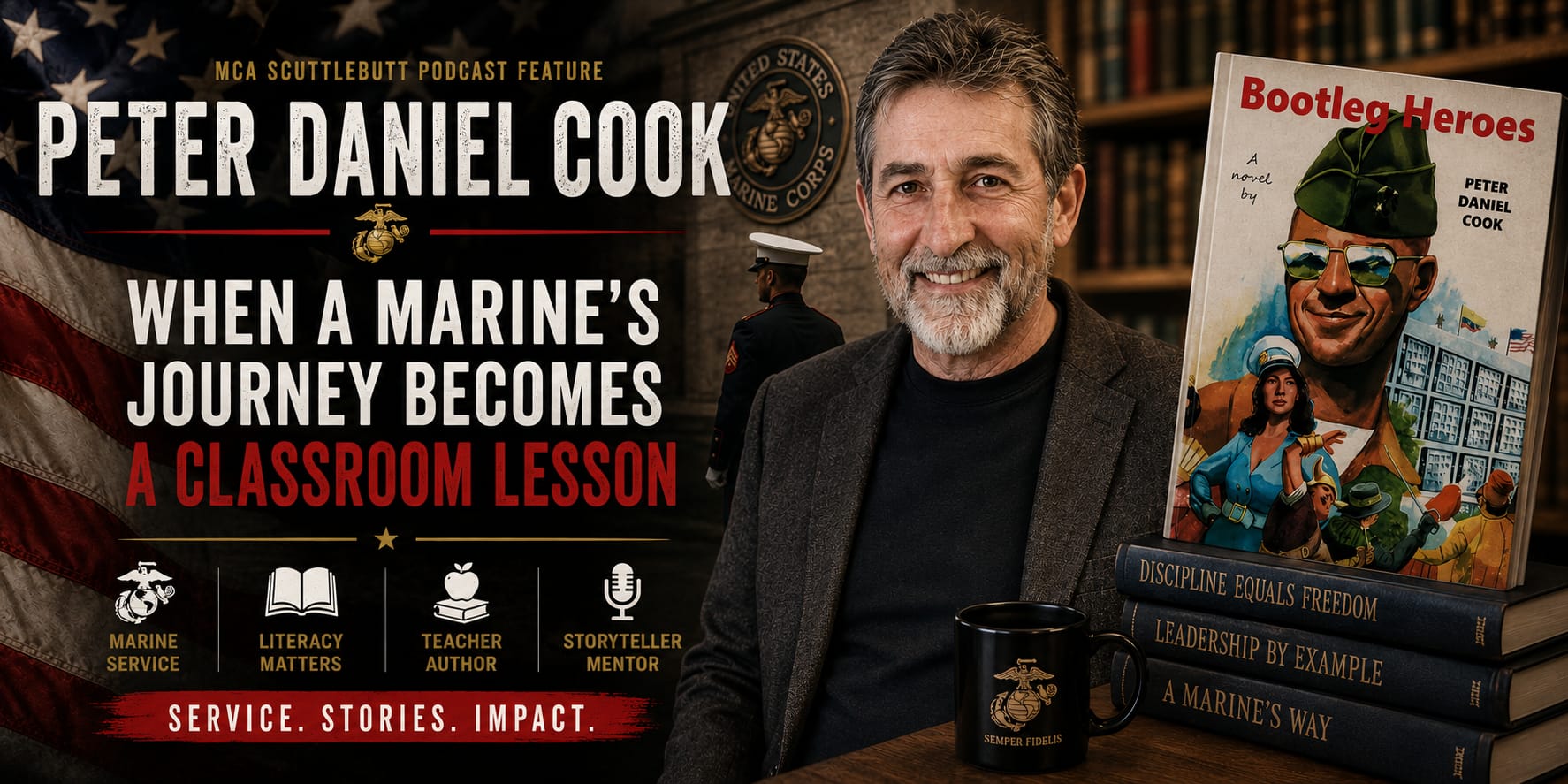
When a Marine’s Journey Becomes a Classroom Lesson
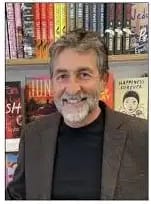
Peter Daniel Cook has lived a life shaped by service. As a Marine Corps embassy security guard, he stood watch in Ecuador, Spain, and Haiti. Those missions demanded vigilance, judgment, and an understanding of human nature that goes far beyond official protocols. Today, those same experiences inform how he teaches economics to high school students and how he tells stories as an author.
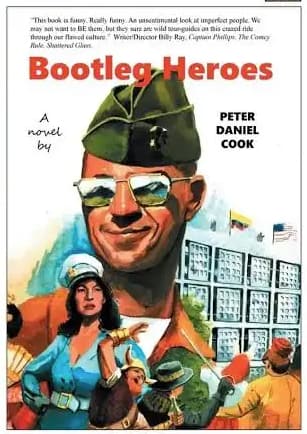
Cook’s new novel, Bootleg Heroes, draws directly from his time in uniform. But it represents something deeper than a memoir: it’s a meditation on how the stories we tell shape who we become, and why literacy matters more now than ever.
“The power of literature is infectious,” Cook explained in a recent conversation with the MCA Scuttlebutt Podcast. And listening to him talk about his work, you understand he means that literally. His passion for reading, writing, and teaching doesn’t just inform his classroom; it defines his mission beyond it.
Service That Transforms
Before Peter Daniel Cook became a high school teacher, he was a Marine serving in critical diplomatic posts. Embassy security work is unglamorous but vital. Guards don’t make headlines. They prevent crises. They build trust. They learn to read situations and people with precision.
For Cook, that experience became a laboratory for understanding character, risk, and resilience. The scenarios he witnessed, both ordinary and extraordinary, gave him material that felt authentic, stakes that mattered, and insights into how ordinary people navigate extraordinary circumstances.
When he left the Marine Corps, Cook didn’t abandon those lessons. Instead, he began translating them into a new context: the American classroom, where economics textbooks compete with smartphones and social media for students’ attention.
Teaching Economics With a Marine’s Perspective
Economics is often taught as theory: graphs, models, principles abstracted from real life. But Cook brings something different: the perspective of someone who’s seen how real economies work at the margins, who’s understood scarcity and survival, who knows the cost of poor decisions in environments where there are no second chances.
His students don’t just learn about supply and demand. They learn about the human beings behind those systems. And crucially, they learn that understanding economics is a form of literacy—a way of reading the world that gives you power and agency.
“Literacy,” Cook emphasizes, “is about far more than reading words on a page. It’s about understanding the systems that shape your life, and having the tools to navigate them.”
That’s why he writes. That’s why he teaches. And that’s why Bootleg Heroes matters.
Bootleg Heroes: Fiction Inspired by Service
Released last year, Bootleg Heroes is a work of fiction, but it’s informed and inspired by Cook’s real experiences. The novel explores themes of loyalty, survival, moral ambiguity, and the small acts of courage that define ordinary people in difficult places.
The title itself is telling. A “bootleg hero” isn’t the kind of person who makes the history books. They’re the people who do the right thing quietly, often without recognition. They’re the Marines who served in embassy details. They’re the teachers who stay late to help struggling students. They’re the people who understand that heroism is less about dramatic gestures and more about showing up, paying attention, and doing the work.
In our current moment, when attention spans are fracturing and information overload drowns out reflection, the novel serves as an argument for the power of narrative. Stories make us human. They teach us empathy. They show us possibilities we couldn’t imagine on our own.
Why Marines Should Read (And Write)
There’s a long tradition in the Marine Corps of leaders who are readers. The Marine Corps reading lists, professional development programs, and emphasis on continuous learning all reflect an institutional belief: that reading and reflection make you a better Marine.
Peter Daniel Cook exemplifies that tradition. His military service didn’t end when he left active duty. It evolved. Now he serves through education, dedicating his life to creating citizens who can think critically, understand systems, and navigate complexity.
For other Marines considering their post-service paths, whether that’s teaching, writing, business, or any field, Cook’s example is worth studying. The skills that made you effective in uniform (leadership, problem-solving, attention to detail, understanding of human nature) don’t disappear. They translate. They compound. They give you an unfair advantage in whatever you do next.
Literacy as a Foundation for Everything
Cook’s emphasis on literacy deserves special attention. In an era when reading is often treated as optional, when many Americans rarely read books, and when media literacy is under siege, his advocacy is urgent.
Real, deep literacy does several things:
- It builds empathy by allowing us to live inside other people’s minds
- It develops reasoning by requiring sustained attention and complex thought
- It creates a buffer against manipulation and propaganda
- It connects us to human culture across time and geography
- It gives us agency by expanding our understanding of what’s possible
For veterans, literacy takes on additional weight. PTSD, isolation, identity disruption. Many of the challenges veterans face can be addressed through reading and writing. Stories help us make sense of chaos. They connect us to others who’ve experienced similar struggles. They remind us we’re not alone.
A Model for Second Careers
Peter Daniel Cook’s path from Marine to educator to author isn’t rare among veterans, but it’s not common either. What’s distinctive is how deliberately he’s built on his service experience rather than abandoning it.
His students know he’s a veteran. That fact carries weight. It shapes how they listen to him. It gives his lessons about discipline, accountability, and perseverance real credibility. It also models something important: that service doesn’t end at the gate, and that the mission you served in the military can have a second life in civilian roles.
For Marines considering what comes next, the question isn’t “How do I leave my military identity behind?” but rather “How do I evolve my service into a new context?”
For Peter Daniel Cook, that evolution led to teaching and writing. For others, it might be business, medicine, law, community organizing, or nonprofit work. The specific field matters less than the commitment: to keep serving, to keep developing, to keep working toward something bigger than yourself.
Listen to Peter Daniel Cook’s Story
The MCA Scuttlebutt Podcast (Episode #227) features an extended conversation with Peter Daniel Cook about his experiences, his motivations, and his vision for education. It’s worth your time, especially if you’re a Marine or veteran thinking about your own second act.
You can find the podcast on Apple Podcasts, Spotify, or Amazon Music.
You can also learn more about Peter’s work at peterdanielcook.com.
The Bottom Line
Peter Daniel Cook’s story is about more than one Marine’s career transition. It’s about the enduring power of stories to shape how we understand the world. It’s about literacy as a tool for agency and empathy. And it’s about the reality that your service, whether it’s in uniform or in a classroom, is an investment that compounds for decades.
In choosing to teach and write, Peter Daniel Cook has stayed in the fight. He’s simply changed the battleground. And that’s the real lesson of his story.
Have a story about your transition from military service to a civilian career? Share it with us. Send stories and tips to Contact Us