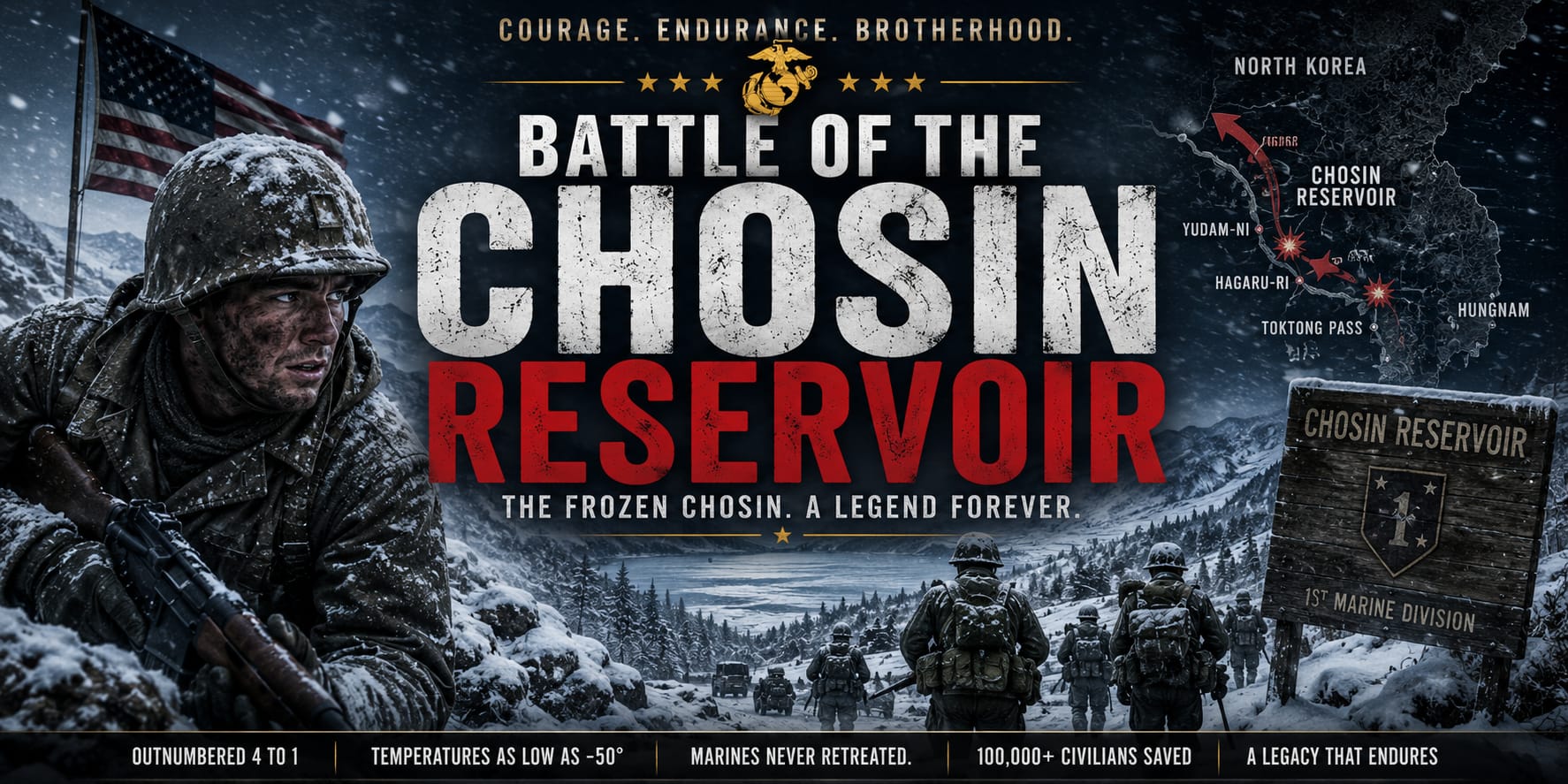
Battle of Chosin Reservoir. How the Frozen Chosin Became a Marine Corps Legend
Source: Please Visit and Support: Merch Store & ALL Other Links: https://thefatelectrician.com/ & YouTube Channel: https://www.youtube.com/@the_fat_electrician
The Battle of Chosin Reservoir. How the Frozen Chosin Became a Marine Corps Legend
Few battles in American military history tested the limits of human endurance like the Battle of Chosin Reservoir.
In the winter of 1950, nearly 15,000 United States Marines, alongside approximately 3,000 U.S. Army soldiers, found themselves surrounded deep inside North Korea by an estimated 120,000 Chinese Communist troops. Cut off from friendly forces, fighting in temperatures that dropped below 50 degrees below zero, they faced overwhelming odds that would have broken most armies.
Instead of surrendering, they fought their way through.
The Battle of Chosin Reservoir became one of the Marine Corps’ defining moments and earned the men who survived a name still spoken with pride today.
The Chosin Few.
The Road to Chosin
The Korean War began on June 25, 1950, when North Korean forces crossed the 38th Parallel and invaded South Korea.
Backed by Soviet equipment and training, North Korean troops quickly captured Seoul and pushed South Korean and United Nations forces into a small defensive perimeter around the port city of Pusan.
General Douglas MacArthur responded with one of history’s most successful amphibious assaults.
Operation Chromite.
On September 15, 1950, Marines landed at Inchon, recaptured Seoul, and shattered North Korean supply lines. Within weeks, United Nations forces had liberated South Korea and pushed north toward the Chinese border.
Success brought new risks.
Despite warnings that Communist China might intervene if American forces approached the Yalu River, the advance continued deeper into North Korea.
An Enemy Hidden in the Mountains
By late November, Chinese forces had quietly crossed into North Korea under the cover of darkness.
Their objective was simple.
Destroy the advancing United Nations forces.
The 1st Marine Division, commanded by Major General Oliver P. Smith, established positions around the Chosin Reservoir. Unlike some senior commanders who believed victory was near, Smith anticipated trouble.
He ordered supplies stockpiled.
He insisted on constructing an airstrip at Hagaru-ri.
Those decisions would save thousands of lives in the days ahead.
The Attack Begins
On the night of November 27, 1950, bugles echoed across the frozen mountains.
Then came wave after wave of Chinese infantry.
Marines scrambled from their sleeping bags as frozen weapons refused to function. Many stripped lubricant from their rifles because ordinary gun oil turned to jelly in the bitter cold.
Some Marines fought wearing only socks after rushing from their tents without enough time to put on frozen boots.
The fighting quickly became hand-to-hand.
Machine guns, rifles, bayonets, and grenades kept the Chinese attacks at bay throughout the night.
Despite being heavily outnumbered, Marine defensive positions held.
Fox Company Holds the Line
One of the battle’s greatest stories belongs to Fox Company, 2nd Battalion, 7th Marines.
Only 234 Marines defended Toktong Pass, a narrow mountain choke point that controlled the only road connecting thousands of Marines farther north with friendly forces.
If Fox Company fell, the Marines at Yudam-ni would be trapped.
Captain William Barber refused to yield.
Even after suffering a gunshot wound to the leg, Barber remained with his Marines, directing the defense while moving through the lines on crutches.
By dawn, Fox Company still held the pass.
The Marines had suffered heavy casualties.
Chinese losses numbered in the thousands.
For his leadership, Captain Barber received the Medal of Honor.
“We’re Not Retreating”
As Chinese attacks intensified, General Oliver Smith rejected the idea that the Marines were retreating.
His words became legendary.
“We are not retreating. We are simply attacking in another direction.”
Rather than surrender or abandon their wounded, the Marines organized a fighting breakout toward the port of Hungnam.
Every mile south required another battle.
Every convoy protected hundreds of wounded Marines.
Every position had to be fought for before the column could continue moving.
Chesty Puller’s Leadership
Lieutenant General Lewis “Chesty” Puller commanded Marines defending the southern route at Koto-ri.
When told his forces were surrounded, Puller delivered one of the most famous quotes in Marine Corps history.
“We’re surrounded. That simplifies the problem.”
The enemy stood on every side.
That also meant there was an opportunity to attack in every direction.
Puller’s leadership helped maintain morale during one of the Corps’ darkest moments.
Tootsie Rolls That Saved Lives
One of the battle’s most enduring stories involves an unexpected shipment.
Marines requested 60 mm mortar ammunition, commonly nicknamed “Tootsie Rolls.”
Instead, they received pallets of the actual candy.
While the mistake provided welcome morale during brutal fighting, Marines soon discovered another use.
When chewed, Tootsie Rolls became a sticky adhesive that temporarily repaired damaged fuel lines and equipment in the freezing temperatures.
What began as a supply error became another example of Marines adapting under impossible conditions.

Engineering Under Fire
As the breakout continued, Chinese forces destroyed a critical bridge spanning a deep mountain gorge.
Without it, thousands of Marines, Army soldiers, vehicles, and wounded personnel faced destruction.
American engineers and Air Force crews responded with remarkable speed.
Portable bridge sections were flown into Korea, parachuted into the combat zone, transported under enemy fire, and assembled in less than two days.
The convoy continued moving.
Another obstacle had been overcome.
Saving More Than Marines
The breakout eventually reached Hungnam.
There, another remarkable mission unfolded.
More than 100,000 Korean civilians fled toward United Nations positions, desperate to escape advancing Communist forces.
Despite the enormous logistical challenge, American forces evacuated the civilians alongside military personnel during one of history’s largest humanitarian evacuations.
Many South Korean families today trace their survival to that operation.
The Battle of Chosin Reservoir became more than a military victory.
It became a mission that preserved countless civilian lives.
The Legacy of the Frozen Chosin
The Battle of Chosin Reservoir cost the United States dearly.
More than a thousand Americans were killed in combat.
Thousands more suffered wounds and severe frostbite.
Chinese casualties were even greater, with estimates ranging from more than 40,000 to over 60,000 killed, wounded, or incapacitated.
The battle produced 17 Medals of Honor, 73 Navy Crosses, and countless acts of heroism that continue to define Marine Corps history.
Why Chosin Still Matters
The Battle of Chosin Reservoir was never simply about surviving impossible odds.
It demonstrated disciplined leadership under pressure.
It proved the value of preparation, logistics, and teamwork.
It showed that courage is measured not only by holding a position, but by refusing to leave behind fellow Marines or innocent civilians.
More than seventy years later, the story of the Frozen Chosin continues to remind every Marine what can be accomplished through determination, sacrifice, and unwavering commitment to one another.
Semper Fidelis.