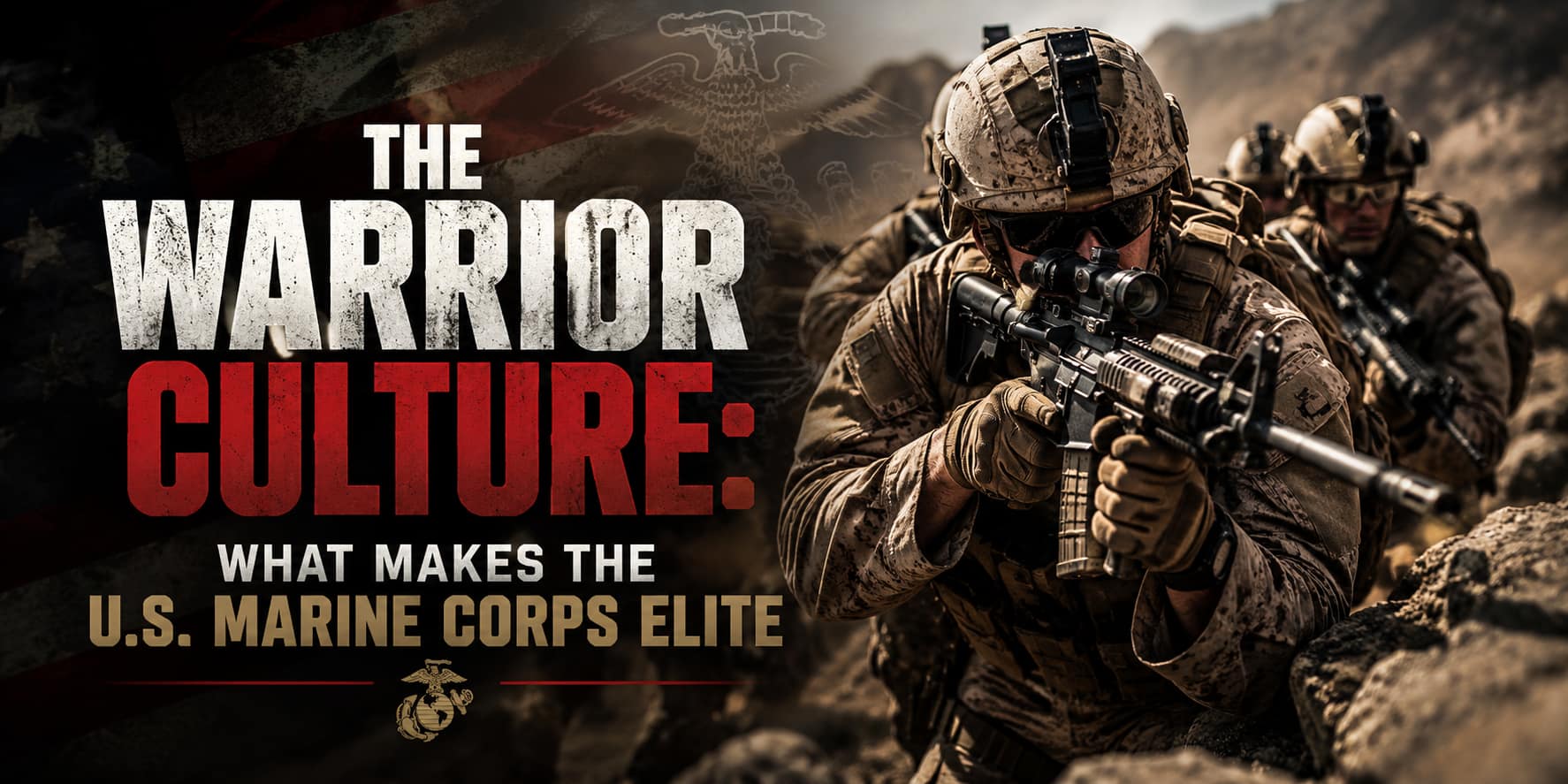
The Warrior Culture: What Makes the U.S. Marine Corps Elite
The Marines: The Tip of the Spear of the US Armed Forces | ENDEVR Documentary
“From Raw Recruit to Battle-Ready Warrior”: Inside the U.S. Marine Corps School of Infantry
When young Marines graduate from boot camp, they’re just beginning their journey. The real transformation happens at the U.S. Marine Corps School of Infantry (SOI) at Camp Pendleton, California—a grueling 59-day graduate school of combat that turns civilians into warriors.
The Graduate School of Combat
Every year, 38,000 new Marines enter SOI after surviving boot camp. What they don’t know is that boot camp was just the prerequisite. At Camp Pendleton’s sprawling 300+ square mile base, these young men face the hardest training of any branch of the U.S. military.
Sergeant Steven Helman, a veteran Marine instructor, explains the mission clearly: “We’re trying to make sure only the strong ones get through here so we’re not sending a weak product out to the Fleet Marine Force.”
The standards are unforgiving. Competition is brutal. Tolerance for failure is low. And that’s exactly how it should be—because these Marines are training to defend lives.
Mastering Firepower: From the M240 to the .50 Cal
The first phase focuses on weapons mastery. Marines don’t just fire guns at SOI; they become experts in the most powerful weapons in the military arsenal.
The M240 Machine Gun
New Marines spend a week studying the M240—a general-purpose machine gun that fires 7.62mm rounds effective up to 3,725 meters. They disassemble it, reassemble it, memorize every component. One trainee said, “When I go to sleep, I have a 240 in my head.”
On the range, they face a brutal requirement: an 80% hit rate with 1,200 rounds. As rounds echo across Camp Pendleton, instructors watch for precision and discipline. Marines learn “talking guns”—a tactic where two sets of guns coordinate fire, creating continuous suppression while one reloads.
The .50 Caliber: The Big Brother
By week two, Marines step up to the M2 .50 caliber machine gun—a weapon that demands respect. Rounds the size of your thumb can pierce through Humvee steel, concrete, and mud walls. The firing rate? Over 500 rounds per minute.
A two-Marine crew must master the M2’s elaborate firing process: clear the weapon, load the ammunition, condition the gun. Instructors stand beside each shooter as they fire for the first time. The recoil is intense. The sound is deafening. One young Marine said, “My adrenaline got pumped so hard that my goggles started fogging up.”
The Small: Shoulder-Fired Rockets
On day 45, Marines are introduced to the Mark 153 SMAW (Small Assault Weapon)—a shoulder-fired rocket launcher descended from WWII bazookas but with devastating modern firepower. These weapons can eliminate armored vehicles, destroy reinforced bunkers, and level fortified buildings.
Marines must hit an 80% target rate or get cut from the program. Training is intense because the consequences of failure in combat are deadly.
Team Weapons: Mortars and Coordinated Fire
While some Marines specialize in individual weapons, others learn to coordinate team-based systems. The 60mm mortar—a weapon that has defended Marines since World War II—requires perfect teamwork. Speed is critical: if you can be seen by the enemy, they can shoot back. Teams must set up mortars, acquire targets, fire, and move before enemy fire finds them.
Sergeant instructors witness young Marines mature during this phase. “They basically start getting more mature. They understand that we’re going to give them tasks to do by themselves and to actually do it by themselves without anyone telling them to do it,” one instructor observed.
Up Close and Personal: Room Clearing
After six weeks of long-distance firepower, Marines face real urban combat—room clearing. In Afghanistan and Iraq, 90% of combat occurs in buildings. At a mockup village, Marines practice the most intense close-quarters combat.

Using live ammunition, Marines must clear rooms with precision and discipline:
- Check fatal fronts (immediate threats)
- Double tap (hammer pairs) to the chest
- One shot to the head to ensure the target is down
- Move to the next room if necessary
Instructors stand behind each Marine, correcting mistakes immediately. “When you get in country, there’s not going to be those safety checks. And the last thing you want to do is hurt another Marine. So if they’re yelling, it’s for a damn good reason,” one instructor explains.
The stress is real. The weapons are live. The mistakes can be lethal.
Air Support: Cobras and Hueys
Marines don’t fight alone. Above them, AH-1 Cobra attack helicopters and UH-1 Huey gunships provide devastating air support.
The Cobra is a sleek 58-foot aircraft with a single mission: deliver ordinance against the enemy. Its 20mm cannon fires 750 rounds per minute. Its Hydra rockets—five pounds of high explosive each—create kill zones of 150 feet. A single Cobra can carry 19 of these devastating rockets on each wing.
The Huey, a Vietnam-era workhorse modernized for today’s warfare, carries a .50 caliber machine gun on one side and a GAU7 minigun (3,000 rounds per minute) on the other.
Marine pilots understand their role: “Our sole purpose in life is to support that individual Marine on the ground. Being a Marine pilot, you’re a Marine first, aviator second.”
Mojave Viper: The Final Crucible
After 59 days of training, Marines who have survived the cut face their ultimate test: Mojave Viper, a 30-day, live-fire combat exercise in the Mojave Desert.
Range 400 is legend in the Marine Corps—a literal crucible that has advanced countless rifle companies and broken a few as well. On this range, everything learned over three months converges: machine gun suppression, mortar fire, air support, room clearing, individual weapon skills, and squad coordination.
Marines assault a small objective across hundreds of yards of enemy terrain. Mortars rain destruction. Machine gun fire keeps the enemy’s heads down. Air support tracks overhead. Infantry assaults the position.
It’s loud. It’s dangerous. It’s as close to real combat as training gets. After three grueling hours, Marines reach their objective. They’ve survived the crucible.
From Citizen to Warrior
The transformation is remarkable. Young men arrive as civilians—some from small towns, some with dreams of film school, some simply seeking adventure. They leave as thinking warriors, not just acting robots.
One Marine reflected on his journey: “I think it was the transformation of a person. Looking at who I was before I went through it and who I was after—there was definitely a huge transformation and it was the best thing I ever did in my life.”
They’ve learned to master weapons, work as a team, think tactically, and trust their brothers-in-arms with their lives. They’ve been forged in fire and tested under live rounds.
59 days at the School of Infantry. 30 days at Mojave Viper. And a batch of young men transformed from citizens into battle-ready Marines, ready to protect and defend their nation wherever it may send them.
They are the future defenders of freedom. They are the U.S. Marine Corps.
Semper Fidelis.
From the Creator
The United States Marine Corps (USMC) is a branch of the US Armed Forces under the Department of the Navy. Despite its naval affiliation, it maintains comprehensive land, air, and sea capabilities.
As of 2020, it comprised approximately 181,000 active-duty personnel, 35,500 reservists, and 19,000 civilians. The Marines function as a rapid response force specializing in expeditionary and amphibious warfare, earning their elite status through rigorous training and strong unit cohesion.
Additionally, Marines serve aboard Navy vessels and protect sensitive US facilities worldwide, including embassies.
SOURCE – Support Endevr
Subscribe to ENDEVR for free: https://bit.ly/3e9YRRG
Facebook: https://bit.ly/2QfRxbG
Instagram: / endevrdocs